Submitted by xunyoyo 183 The Devil Behind Moltbook: Anthropic Safety is Always Vanishing in Self-Evolving AI Societies · 13 authors 9
Submitted by xx18 86 Composition-RL: Compose Your Verifiable Prompts for Reinforcement Learning of Large Language Models Tencent Hunyuan 17 2
Submitted by myownskyW7 73 DeepGen 1.0: A Lightweight Unified Multimodal Model for Advancing Image Generation and Editing Shanghai Innovation Institute 77 3
Submitted by Keven16 56 Learning beyond Teacher: Generalized On-Policy Distillation with Reward Extrapolation Tencent Hunyuan 13 2
Submitted by Jeff-Wang 47 GigaBrain-0.5M*: a VLA That Learns From World Model-Based Reinforcement Learning GigaAI 2.3k 2
Submitted by fdugyt 47 MOSS-Audio-Tokenizer: Scaling Audio Tokenizers for Future Audio Foundation Models OpenMOSS 89 4
Submitted by zhaocheng 43 NarraScore: Bridging Visual Narrative and Musical Dynamics via Hierarchical Affective Control ByteDance 2
Submitted by SnowNation 31 LawThinker: A Deep Research Legal Agent in Dynamic Environments Renmin University of China 24 2
Submitted by chengtan9907 31 Thinking with Drafting: Optical Decompression via Logical Reconstruction ByteDance 3
Submitted by jayinnn 26 Stroke of Surprise: Progressive Semantic Illusions in Vector Sketching National Yang Ming Chiao Tung University 26 2
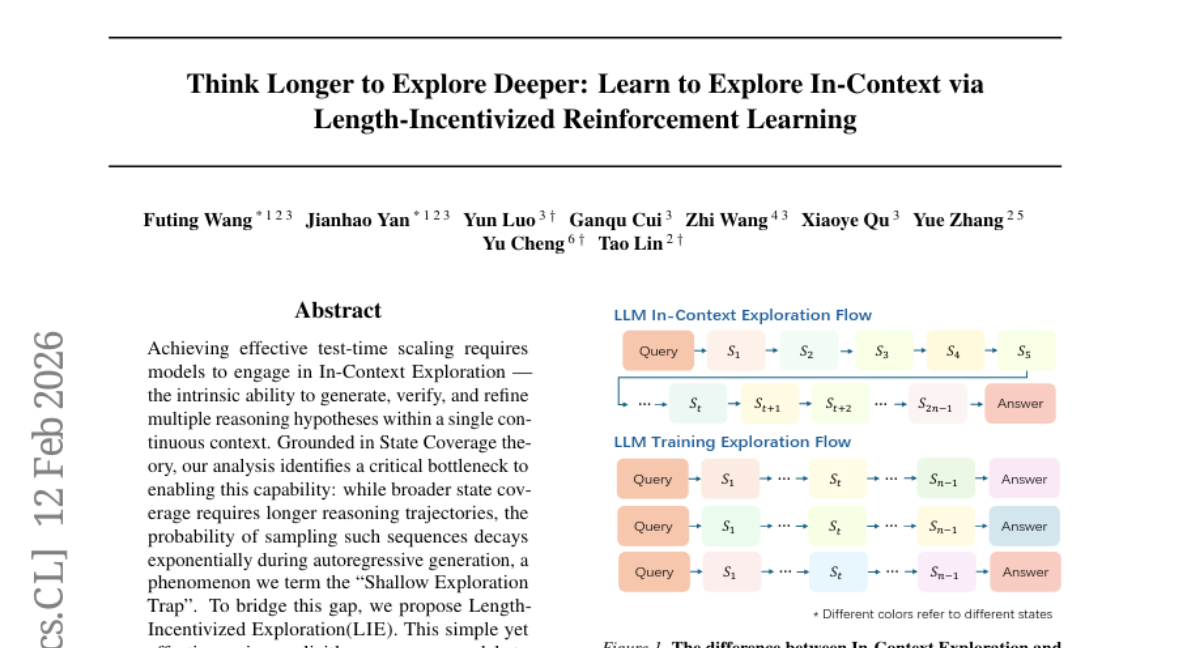
Submitted by ramiroluo 26 Think Longer to Explore Deeper: Learn to Explore In-Context via Length-Incentivized Reinforcement Learning Westlake University 13 2
Submitted by JiazhiYang 26 RISE: Self-Improving Robot Policy with Compositional World Model OpenDriveLab 2
Submitted by Chonghao 25 χ_{0}: Resource-Aware Robust Manipulation via Taming Distributional Inconsistencies The University of Hong Kong 186 2
Submitted by ModiShi 20 EgoHumanoid: Unlocking In-the-Wild Loco-Manipulation with Robot-Free Egocentric Demonstration · 9 authors 2
Submitted by ilnehc 17 Sparse Video Generation Propels Real-World Beyond-the-View Vision-Language Navigation · 8 authors 35 2
Submitted by Liangqiong-QU 11 Unveiling Implicit Advantage Symmetry: Why GRPO Struggles with Exploration and Difficulty Adaptation The University of Hong Kong 10 2
Submitted by MatteoNulli 10 Adapting Vision-Language Models for E-commerce Understanding at Scale eBay 4
Submitted by vztu 10 PISCO: Precise Video Instance Insertion with Sparse Control Texas A&M University 30 2
Submitted by Tyrion279 8 T3D: Few-Step Diffusion Language Models via Trajectory Self-Distillation with Direct Discriminative Optimization · 12 authors 14 2
Submitted by taesiri 8 Gaia2: Benchmarking LLM Agents on Dynamic and Asynchronous Environments Meta Research 2
Submitted by visity 7 MemFly: On-the-Fly Memory Optimization via Information Bottleneck · 7 authors 3
Submitted by XinXuNLPer 6 ThinkRouter: Efficient Reasoning via Routing Thinking between Latent and Discrete Spaces · 6 authors 2
Submitted by kmitsides 6 Dreaming in Code for Curriculum Learning in Open-Ended Worlds Imperial College London 1 2
Submitted by taesiri 5 MiniCPM-SALA: Hybridizing Sparse and Linear Attention for Efficient Long-Context Modeling OpenBMB 1
Submitted by taesiri 5 MolmoSpaces: A Large-Scale Open Ecosystem for Robot Navigation and Manipulation AI21 95 1
Submitted by zjr2000 4 Pretraining A Large Language Model using Distributed GPUs: A Memory-Efficient Decentralized Paradigm The Hong Kong Polytechnic University 17 3
Submitted by MING-ZCH 4 MetaphorStar: Image Metaphor Understanding and Reasoning with End-to-End Visual Reinforcement Learning · 3 authors 4 2
Submitted by mathieu-sibue 3 ExStrucTiny: A Benchmark for Schema-Variable Structured Information Extraction from Document Images JP Morgan Chase 2
Submitted by sY713 3 Sci-CoE: Co-evolving Scientific Reasoning LLMs via Geometric Consensus with Sparse Supervision Intern Science 2 2
Submitted by tnlin 3 P-GenRM: Personalized Generative Reward Model with Test-time User-based Scaling Tongyi-ConvAI 13 3
Submitted by leolhb 3 Budget-Constrained Agentic Large Language Models: Intention-Based Planning for Costly Tool Use Renmin University of China 2
Submitted by MaplesWCT 2 ScalSelect: Scalable Training-Free Multimodal Data Selection for Efficient Visual Instruction Tuning Zhongguancun Academy 2 2
Submitted by taesiri 2 ABot-N0: Technical Report on the VLA Foundation Model for Versatile Embodied Navigation · 44 authors 40 1
Submitted by TeddyXGZ 2 Neural Additive Experts: Context-Gated Experts for Controllable Model Additivity · 3 authors 2 2
Submitted by slseanwu 2 Stemphonic: All-at-once Flexible Multi-stem Music Generation Massachusetts Institute of Technology 3
Submitted by StevenZHB 1 Detecting RLVR Training Data via Structural Convergence of Reasoning Text Intelligence Lab of Westlake University 1 2



 xunyoyo