

paper_name stringlengths 4 421 | paper_url stringlengths 21 200 | paper_authors listlengths 0 125 | paper_abstract stringlengths 0 43.4k | paper_code stringlengths 1 139 | conf stringlengths 6 18 |
|---|---|---|---|---|---|
Advances in Cryptology - CRYPTO 2026 - 46th Annual International Cryptology Conference, Santa Barbara, CA, USA, August 17-20, 2026, Proceedings, Part I | https://doi.org/10.1007/978-3-032-35367-2 | [
"Nadia Heninger",
"Mike Rosulek"
] | # | CRYPTO2026 | |
Pseudo-Equilibria, Or: How to Stop Worrying About Crypto and Just Analyze the Game | https://doi.org/10.1007/978-3-032-35367-2_1 | [
"Alexandros Psomas",
"Athina Terzoglou",
"Yu Wei",
"Vassilis Zikas"
] | # | CRYPTO2026 | |
Security Amplification via Robust Indistinguishability Combiners | https://doi.org/10.1007/978-3-032-35367-2_2 | [
"Benny Applebaum",
"Nir Bitansky",
"Nathan Geier"
] | # | CRYPTO2026 | |
A Unifying Umbrella for Circular-Secure Cryptographic Primitives | https://doi.org/10.1007/978-3-032-35367-2_3 | [
"Fuyuki Kitagawa",
"Takahiro Matsuda"
] | # | CRYPTO2026 | |
On the Complexity of Interactive Arguments | https://doi.org/10.1007/978-3-032-35367-2_4 | [
"Idan Baril",
"Iftach Haitner"
] | # | CRYPTO2026 | |
Non-trivial Zero-Knowledge Implies One-Way Functions | https://doi.org/10.1007/978-3-032-35367-2_5 | [
"Suvradip Chakraborty",
"James Hulett",
"Dakshita Khurana",
"Kabir Tomer"
] | A recent breakthrough [Hirahara and Nanashima, STOC'2024] established that if $\mathsf{NP} \not \subseteq \mathsf{ioP/poly}$, the existence of zero-knowledge with negligible errors for $\mathsf{NP}$ implies the existence of one-way functions (OWFs). In this work, we obtain a characterization of one-way functions from t... | # | CRYPTO2026 |
Lower Bounds on Black-Box Constructions of Pseudorandom Functions | https://doi.org/10.1007/978-3-032-35367-2_6 | [
"Bar Alon",
"Itai Dinur",
"Muthuramakrishnan Venkitasubramaniam"
] | In their seminal work, Goldreich, Goldwasser, and Micali [CRYPTO 1984] constructed a pseudorandom function (PRF) using a black-box access to a pseudorandom generator (PRG). When combined with Levin's domain extension technique, the GGM construction invokes the PRG $ω(\log n)$ times, where $n$ denotes the input length t... | # | CRYPTO2026 |
Unique SNARGs with Adaptive Security: Constructions and Black-Box Separations | https://doi.org/10.1007/978-3-032-35367-2_7 | [
"Cody Freitag",
"Daniel Wichs"
] | # | CRYPTO2026 | |
Bulletproofs are Optimal: Lower Bounds for Vector Commitments from Fiat-Shamir in Pairing-Free Groups | https://doi.org/10.1007/978-3-032-35367-2_8 | [
"Marian Dietz",
"Emanuele Giunta"
] | # | CRYPTO2026 | |
Achieving Shannon Capacity for Computationally Bounded Errors | https://doi.org/10.1007/978-3-032-35367-2_9 | [
"George Lu",
"Jad Silbak",
"Daniel Wichs"
] | # | CRYPTO2026 | |
Chosen Ciphertext Secure Pseudorandom Codes in the Standard Model | https://doi.org/10.1007/978-3-032-35367-2_10 | [
"Nico Döttling",
"Antoine Joux",
"Venkata Koppula",
"Mahesh Sreekumar Rajasree",
"Hendrik Waldner"
] | # | CRYPTO2026 | |
How to Use Polynomially-Hard iO: Turing Machine Obfuscation and More | https://doi.org/10.1007/978-3-032-35367-2_11 | [
"Jesko Dujmovic",
"Yao-Ching Hsieh",
"Abhishek Jain",
"Willy Quach"
] | # | CRYPTO2026 | |
Adaptive NIKE for Unbounded Parties | https://doi.org/10.1007/978-3-032-35367-2_12 | [
"Shafik Nassar",
"Brent Waters"
] | # | CRYPTO2026 | |
Pairing-Based Registered ABE for Boolean Formulas with a Linear-Size CRS | https://doi.org/10.1007/978-3-032-35367-2_13 | [
"Roy Stracovsky",
"Brent Waters",
"David J. Wu"
] | # | CRYPTO2026 | |
Equivocal Broadcast Encryption: Adaptively-Secure Optimal Distributed Broadcast Encryption from Lattices | https://doi.org/10.1007/978-3-032-35367-2_14 | [
"Rishab Goyal",
"Saikumar Yadugiri"
] | # | CRYPTO2026 | |
Advanced Cryptography from Lattice Isomorphism - New Constructions of IBE and FHE | https://doi.org/10.1007/978-3-032-35367-2_15 | [
"Huck Bennett",
"Zhengnan Lai",
"Noah Stephens-Davidowitz"
] | # | CRYPTO2026 | |
Unbounded Broadcast and KP-ABE with Sublinear Ciphertext from Pairings | https://doi.org/10.1007/978-3-032-35367-2_16 | [
"Junichi Tomida",
"Hoeteck Wee"
] | # | CRYPTO2026 | |
Collusion-Resistant Constrained PRFs for Compute- &-Compare Predicates from LWE | https://doi.org/10.1007/978-3-032-35367-2_17 | [
"Jiaqi Cheng",
"Rishab Goyal"
] | # | CRYPTO2026 | |
How to Encrypt with Random Reversible Circuits: Functional, Homomorphic and CCA-Secure | https://doi.org/10.1007/978-3-032-35367-2_18 | [
"Ran Canetti",
"Ji Luo",
"Yiding Zhang"
] | # | CRYPTO2026 | |
Generic-Group Barriers for Function-Hiding and Multi-input Functional Encryption | https://doi.org/10.1007/978-3-032-35367-2_19 | [
"Mohammad Hajiabadi",
"Roman Langrehr",
"Mingyuan Wang"
] | # | CRYPTO2026 | |
Advances in Cryptology - CRYPTO 2026 - 46th Annual International Cryptology Conference, Santa Barbara, CA, USA, August 17-20, 2026, Proceedings, Part V | https://doi.org/10.1007/978-3-032-35409-9 | [
"Nadia Heninger",
"Mike Rosulek"
] | # | CRYPTO2026 | |
Cryptomania v.s. Minicrypt in a Quantum World | https://doi.org/10.1007/978-3-032-35409-9_1 | [
"Longcheng Li",
"Qian Li",
"Xingjian Li",
"Qipeng Liu"
] | # | CRYPTO2026 | |
Multi-copy Security in Quantum Cryptography and More | https://doi.org/10.1007/978-3-032-35409-9_2 | [
"Alper Çakan",
"Vipul Goyal",
"Fuyuki Kitagawa",
"Ryo Nishimaki",
"Takashi Yamakawa"
] | # | CRYPTO2026 | |
Constant-Rate Certified Deletion | https://doi.org/10.1007/978-3-032-35409-9_3 | [
"Kai-Min Chung",
"Tzu-Hsiang Huang",
"Wei-Hsiang Hung",
"Shota Yamada"
] | # | CRYPTO2026 | |
A Unified Approach to Quantum Key Leasing with a Classical Lessor | https://doi.org/10.1007/978-3-032-35409-9_4 | [
"Fuyuki Kitagawa",
"Jiahui Liu",
"Shota Yamada",
"Takashi Yamakawa"
] | # | CRYPTO2026 | |
Less is More: On Copy Complexity in Quantum Cryptography | https://doi.org/10.1007/978-3-032-35409-9_5 | [
"Prabhanjan Ananth",
"Eli Goldin"
] | # | CRYPTO2026 | |
Anonymous Public-Key Quantum Money and Universally Verifiable Quantum Voting | https://doi.org/10.1007/978-3-032-35409-9_6 | [
"Alper Çakan",
"Vipul Goyal",
"Takashi Yamakawa"
] | # | CRYPTO2026 | |
How to Delete Without a Trace: Certified Deniability in a Quantum World | https://doi.org/10.1007/978-3-032-35409-9_7 | [
"Alper Çakan",
"Vipul Goyal",
"Justin Raizes"
] | # | CRYPTO2026 | |
Scalable, Quantum-Accessible, and Adaptive Pseudorandom Quantum State and Pseudorandom Function-Like Quantum State Generators | https://doi.org/10.1007/978-3-032-35409-9_8 | [
"Rishabh Batra",
"Zhili Chen",
"Rahul Jain",
"YaoNan Zhang"
] | We show new constructions for pseudorandom quantum states (PRS) and pseudorandom function-like quantum state (PRFS) generators satisfying scalability, which means the security parameter can be much larger than the number of qubits, quantum accessibility, which means the adversary can provide quantum input, and adaptivi... | # | CRYPTO2026 |
Uncloneable Cryptography in Linear Quantum Memory | https://doi.org/10.1007/978-3-032-35409-9_9 | [
"Andrew Huang",
"Omri Shmueli",
"Vinod Vaikuntanathan",
"Mark Zhandry"
] | # | CRYPTO2026 | |
Separating Non-interactive Classical Verification of Quantum Computation from Falsifiable Assumptions | https://doi.org/10.1007/978-3-032-35409-9_10 | [
"Mohammed Barhoush",
"Tomoyuki Morimae",
"Ryo Nishimaki",
"Takashi Yamakawa"
] | Mahadev [SIAM J. Comput. 2022] introduced the first protocol for classical verification of quantum computation based on the Learning-with-Errors (LWE) assumption, achieving a 4-message interactive scheme. This breakthrough naturally raised the question of whether fewer messages are possible in the plain model. Despite ... | # | CRYPTO2026 |
Unclonable Encryption in the Haar Random Oracle Model | https://doi.org/10.1007/978-3-032-35409-9_11 | [
"James Bartusek",
"Eli Goldin"
] | We construct unclonable encryption (UE) in the Haar random oracle model, where all parties have query access to $U,U^\dagger,U^*,U^T$ for a Haar random unitary $U$. Our scheme satisfies the standard notion of unclonable indistinguishability security, supports reuse of the secret key, and can encrypt arbitrary-length me... | # | CRYPTO2026 |
Public-Key Quantum Fire and Key-Fire From Classical Oracles | https://doi.org/10.1007/978-3-032-35409-9_12 | [
"Alper Çakan",
"Vipul Goyal",
"Omri Shmueli"
] | Quantum fire is a distribution of quantum states that can be efficiently cloned, but cannot be efficiently converted into a classical string. First considered by Nehoran and Zhandry (ITCS'24) and later formalized by Bostanci, Nehoran, Zhandry (STOC'25), quantum fire has strong applications and implications in cryptogra... | # | CRYPTO2026 |
On Scalable Pseudorandom Unitaries and the Unitary Synthesis Problem | https://doi.org/10.1007/978-3-032-35409-9_13 | [
"Zvika Brakerski",
"Henry Yuen"
] | We consider the task of constructing pseudorandom unitaries (PRUs) with scalable security, i.e. families in which the security parameter may vary independently of the dimension (or input bit-length). It is not known whether scalable PRUs can be constructed. In this work we show that if scalable PRUs can be constructed ... | # | CRYPTO2026 |
Private Proofs of When and Where | https://doi.org/10.1007/978-3-032-35409-9_14 | [
"Uma Girish",
"Greg Gluch",
"Shafi Goldwasser",
"Tal Malkin",
"Leo Orshansky",
"Henry Yuen"
] | # | CRYPTO2026 | |
Guess-and-Determine Rebound Revisited: Full Quantum Collision Attack on AES-256 in DM Hash Mode | https://doi.org/10.1007/978-3-032-35409-9_15 | [
"Liyuan Tang",
"Lingyue Qin",
"Shiqi Hou",
"Xiaoyang Dong"
] | # | CRYPTO2026 | |
Classical and Quantum Full Plaintext Recovery for Low-Round Feistel-Type Designs | https://doi.org/10.1007/978-3-032-35409-9_16 | [
"Tingting Guo",
"Peng Wang",
"Jiwu Jing",
"Shuping Mao",
"Gang Liu"
] | # | CRYPTO2026 | |
A Geometric Approach to Quantum Distinguishers | https://doi.org/10.1007/978-3-032-35409-9_17 | [
"Zhili Wu",
"Zhenzhen Bao"
] | # | CRYPTO2026 | |
The Impossibility of Post-quantum Public Indifferentiability for Merkle-Damgård | https://doi.org/10.1007/978-3-032-35409-9_18 | [
"Akinori Hosoyamada"
] | # | CRYPTO2026 | |
Advances in Cryptology - CRYPTO 2026 - 46th Annual International Cryptology Conference, Santa Barbara, CA, USA, August 17-20, 2026, Proceedings, Part VII | https://doi.org/10.1007/978-3-032-35415-0 | [
"Nadia Heninger",
"Mike Rosulek"
] | # | CRYPTO2026 | |
Algebraic Attack on Convolutional Neural Networks with Max Pooling | https://doi.org/10.1007/978-3-032-35415-0_1 | [
"Zirui Chen",
"Shi Tang",
"Zhengchao Gao",
"Yongjia Su",
"Lingyue Qin",
"Xiaoyang Dong"
] | # | CRYPTO2026 | |
Cryptanalytic Extraction of Deep Neural Networks with Non-linear Activations | https://doi.org/10.1007/978-3-032-35415-0_2 | [
"Roderick Asselineau",
"Patrick Derbez",
"Pierre-Alain Fouque",
"Brice Minaud"
] | # | CRYPTO2026 | |
Is the Hard-Label Cryptanalytic Model Extraction Really Polynomial? | https://doi.org/10.1007/978-3-032-35415-0_3 | [
"Akira Ito",
"Takayuki Miura",
"Yosuke Todo"
] | Deep Neural Networks (DNNs) have attracted significant attention, and their internal models are now considered valuable intellectual assets. Extracting such a model via oracle access to a DNN is conceptually similar to extracting a secret key from a block cipher. Consequently, cryptanalytic techniques, particularly dif... | # | CRYPTO2026 |
Unforgeable Watermarks for Language Models via Robust Signatures | https://doi.org/10.1007/978-3-032-35415-0_4 | [
"Huijia Lin",
"Kameron Shahabi",
"Min Jae Song"
] | # | CRYPTO2026 | |
A Little LESS Secure - Side-Channel Attacks Exploiting Randomness Leakage | https://doi.org/10.1007/978-3-032-35415-0_5 | [
"Dina Hesse",
"Elisabeth Krahmer",
"Yi-Fu Lai",
"Jonas Meers"
] | # | CRYPTO2026 | |
Maskaglia: A New, Efficient Approach to Masked Discrete Gaussian Sampling | https://doi.org/10.1007/978-3-032-35415-0_6 | [
"Calvin Abou Haidar",
"Thomas Espitau",
"Clément Hoffmann",
"Mehdi Tibouchi"
] | # | CRYPTO2026 | |
Robust Single-Trace Full-Key Extraction from Million-Point Traces With Cross-Implementation Transfer | https://doi.org/10.1007/978-3-032-35415-0_7 | [
"Aron Gohr",
"Friederike Laus",
"Gregor Leander"
] | # | CRYPTO2026 | |
Bypassing the Random-Probing Model in Masking Security Proofs | https://doi.org/10.1007/978-3-032-35415-0_8 | [
"Julien Béguinot",
"Gianluca Brian",
"Loïc Masure"
] | # | CRYPTO2026 | |
Leakage-Tolerant Circuits Against sfAC0 Leakage | https://doi.org/10.1007/978-3-032-35415-0_9 | [
"Yaohua Ma",
"Yifan Song"
] | # | CRYPTO2026 | |
Secure Computation Against NC1 Leakage Without Secure Hardware | https://doi.org/10.1007/978-3-032-35415-0_10 | [
"Yuyu Wang"
] | # | CRYPTO2026 | |
A Formal Security Proof of Masking - Reduction from Strong Noisy Leakage to Probing Model Without Random Probing and Application to LR Primitive | https://doi.org/10.1007/978-3-032-35415-0_11 | [
"Rei Ueno",
"Akiko Inoue",
"Kazuhiko Minematsu",
"Akira Ito",
"Naofumi Homma"
] | # | CRYPTO2026 | |
Generic-Compatible Distinguishers for Linear Regression Based Attacks | https://doi.org/10.1007/978-3-032-35415-0_12 | [
"Sana Boussam"
] | # | CRYPTO2026 | |
Playing Tag with Okamoto-Schnorr: Three-Move Pairing-Free Blind Signatures from DDH | https://doi.org/10.1007/978-3-032-35415-0_13 | [
"Rutchathon Chairattana-Apirom",
"Michael Reichle",
"Stefano Tessaro"
] | # | CRYPTO2026 | |
Blind Signatures from Arguments of Inequality | https://doi.org/10.1007/978-3-032-35415-0_14 | [
"Michael Klooß",
"Russell W. F. Lai",
"Michael Reichle"
] | # | CRYPTO2026 | |
Improved Concurrent-Secure Blind Schnorr Signatures | https://doi.org/10.1007/978-3-032-35415-0_15 | [
"Pierpaolo Della Monica",
"Ivan Visconti"
] | # | CRYPTO2026 | |
On the Impossibility of Round-Optimal Pairing-Free Blind Signatures in the ROM | https://doi.org/10.1007/978-3-032-35415-0_16 | [
"Marian Dietz",
"Julia Kastner",
"Stefano Tessaro"
] | # | CRYPTO2026 | |
Round-Optimal GUC-Secure Blind Signatures From Minimal Computational and Setup Assumptions - From Minimal Computational and Setup Assumptions | https://doi.org/10.1007/978-3-032-35415-0_17 | [
"Michele Ciampi",
"Pierpaolo Della Monica",
"Ivan Visconti"
] | # | CRYPTO2026 | |
Round-Optimal Threshold Blind Signatures Without Random Oracles | https://doi.org/10.1007/978-3-032-35415-0_18 | [
"Georg Fuchsbauer",
"Fabian Regen",
"Hoeteck Wee"
] | # | CRYPTO2026 | |
Three-Move Blind Signatures in Pairing-Free Groups | https://doi.org/10.1007/978-3-032-35415-0_19 | [
"Yanbo Chen"
] | # | CRYPTO2026 | |
Proceedings of the ACM SIGCOMM 2026 Conference, SIGCOMM 2026, Colorado Convention Center, Denver, CO, USA, August 17-21, 2026 | https://doi.org/10.1145/3789240 | [
"Eric Keller",
"Sangtae Ha",
"Laurent Vanbever",
"Theophilus Benson"
] | # | SIGCOMM2026 | |
KVServe: Service-Aware KV Cache Compression for Communication-Efficient Disaggregated LLM Serving | https://doi.org/10.1145/3789240.3829139 | [
"Zedong Liu",
"Xinyang Ma",
"Dejun Luo",
"Hairui Zhao",
"Bing Lu",
"Wenjing Huang",
"Yida Gu",
"Xingchen Liu",
"Zheng Wei",
"Jinyang Liu",
"Dingwen Tao",
"Guangming Tan"
] | LLMs are widely adopted in production, pushing inference systems to their limits. Disaggregated LLM serving (e.g., PD separation and KV state disaggregation) improves scalability and cost efficiency, but it also turns KV into an explicit payload crossing network and storage boundaries, making KV a dominant end-to-end b... | # | SIGCOMM2026 |
DualPath: Accelerating Agentic LLM Inference by Harvesting Disaggregated KV-Cache Storage I/O | https://doi.org/10.1145/3789240.3829159 | [
"Yongtong Wu",
"Shaoyuan Chen",
"Rilin Huang",
"Yixuan Tan",
"Yinmin Zhong",
"Mingxing Zhang",
"Xin Jin",
"Panpan Huang"
] | The performance of multi-turn, agentic LLM inference is increasingly dominated by KV-Cache storage I/O rather than computation. In prevalent disaggregated architectures, loading the massive KV-Cache from external storage creates a fundamental imbalance: storage NICs on prefill engines become bandwidth-saturated, while ... | # | SIGCOMM2026 |
Efficient Remote KV Cache Reuse with GPU-native Video Codec | https://doi.org/10.1145/3789240.3829120 | [
"Liang Mi",
"Weijun Wang",
"Jinghan Chen",
"Ting Cao",
"Haipeng Dai",
"Yunxin Liu"
] | Remote KV cache reuse fetches KV cache for identical contexts from remote storage, avoiding recomputation, accelerating LLM inference. While it excels in high-speed networks, its performance degrades significantly in bandwidth-limited scenarios. Recent studies address this by transmitting KV caches in compressed form, ... | # | SIGCOMM2026 |
Connex: Endpoint Mobility Primitives for Dynamic LLM Serving | https://doi.org/10.1145/3789240.3829200 | [
"Yanying Lin",
"Vincent Liu",
"Tao Luo",
"ChengZhong Xu",
"Kejiang Ye"
] | Modern LLM serving systems increasingly adopt elastic inference pipelines where stages frequently join, leave, and migrate across nodes. However, existing GPU communication frameworks like NCCL assume static topologies, causing routing failures and P99 latency spikes during worker transitions that violate sub-milliseco... | # | SIGCOMM2026 |
TurboBus: Pooling PCIe Bandwidth for LLM Workloads via Scale-Up Fabrics | https://doi.org/10.1145/3789240.3829130 | [
"Xinyu Yang",
"Kaiqiang Xu",
"Kai Chen"
] | GPU memory offloading is widely adopted for LLM workloads but shifts the bottleneck to GPU-CPU transfers, which can take up to 90% of the end-to-end inference/training time! Paradoxically, over 60% of PCIe bandwidth remains idle. The root cause is that PCIe links are individually bottlenecked but collectively underutil... | # | SIGCOMM2026 |
Towards Efficient Verification of Distributed In-Network Computing Programs | https://doi.org/10.1145/3789240.3829122 | [
"Mingyuan Song",
"Huan Shen",
"Jinghui Jiang",
"Qiang Su",
"Ziheng Zhang",
"Qingyu Song",
"Yuchao Zhang",
"Wanjian Feng",
"Fei Yuan",
"Yitao Xing",
"Wenjia Wei",
"Qiao Xiang",
"Jiwu Shu"
] | Distributed in-network programs are increasingly deployed in data centers for their performance benefits, but shifting application logic to switches also enlarges the failure domain. Ensuring their correctness before deployment is thus critical for reliability. While prior verification frameworks can efficiently verify... | # | SIGCOMM2026 |
When static verification is not enough: revealing BGP bugs at runtime | https://doi.org/10.1145/3789240.3829137 | [
"Pietro Ronchetti",
"Tibor Schneider",
"Laurent Vanbever"
] | Operators go to great lengths to ensure their BGP networks are correct. Yet, despite their efforts, faults still happen due to software or hardware bugs which can often have detrimental network-wide consequences. Today, all operators can do is react to such failures, often only once it is already too late. We present G... | # | SIGCOMM2026 |
Explainable Network Verification via Localized Subspecification | https://doi.org/10.1145/3789240.3829155 | [
"Yongzheng Zhang",
"Yaxuan Lin",
"Haoxian Chen",
"Ruize Ma",
"Amirmohammad Nazari",
"Mukund Raghothaman",
"Peng Zhang"
] | Network verification, synthesis, and repair tools help enforce high-level operational intent, but their limited explainability makes configuration maintenance costly in practice, as operators must still manually reason about large, low-level configurations. We propose localized subspecifications, which explain how indi... | # | SIGCOMM2026 |
VeriLucid: A Verification-aware Data-plane Programming Language | https://doi.org/10.1145/3789240.3829171 | [
"John Sonchack",
"Pamela Zave",
"Jennifer Rexford"
] | Correctness is important in data-plane programs, which run on critical infrastructure connecting millions of users. Verification helps programmers build correct software, but current data-plane tools can only check simple properties or require immense programmer effort. As a solution, this paper introduces the first ve... | # | SIGCOMM2026 |
Elastispec: Formalizing Enterprise Firewall Management with Informal and Elastic Specifications | https://doi.org/10.1145/3789240.3829191 | [
"Chenan Wen",
"Yizhan Qing",
"Curt P. Jansen",
"Xiaokang Qiu",
"Sanjay G. Rao"
] | Managing enterprise network firewalls is an ad-hoc process today, where administrators must extract policies relevant to their enterprises from thousands of natural language vendor documents and tailor them to their unique context. In this paper, we present Elastispec, a first step towards principled management of ente... | # | SIGCOMM2026 |
Trivance: Latency-Optimal AllReduce by Shortcutting Multiport Networks | https://doi.org/10.1145/3789240.3829181 | [
"Anton Juerss",
"Vamsi Addanki",
"Stefan Schmid"
] | AllReduce is a fundamental collective communication operation in distributed computing and a key performance bottleneck for large-scale training and inference. Its completion time is determined by the number of communication steps, which dominate latency-sensitive workloads, and the communication distance affecting bot... | # | SIGCOMM2026 |
OptCCL: Scalable Synthesis of Optimal Collective Communication Algorithms | https://doi.org/10.1145/3789240.3829207 | [
"Richard Shapley",
"Rachit Agarwal",
"David B. Shmoys"
] | We present OptCCL, a technique to synthesize collective communication algorithms that are optimal for a given host and network hardware and topology. OptCCL is general: it enables synthesizing optimal algorithms for all existing collectives, for all existing hardware, and even for multiple concurrent collectives sharin... | # | SIGCOMM2026 |
DynamiQ: Accelerating Gradient Synchronization using Compressed Multi-hop All-reduce | https://doi.org/10.1145/3789240.3829148 | [
"Wenchen Han",
"Shay Vargaftik",
"Michael Mitzenmacher",
"Ran Ben Basat"
] | Multi-hop all-reduce is the de facto backbone of large model training. As the training scale increases, the network often becomes a bottleneck, motivating the reduction of the volume of transmitted data. Accordingly, recent systems have demonstrated significant acceleration of the training process using gradient quanti... | # | SIGCOMM2026 |
ZipCCL: Efficient Lossless Data Compression of Communication Collectives for Accelerating LLM Training | https://doi.org/10.1145/3789240.3829204 | [
"Wenxiang Lin",
"Xinglin Pan",
"Ruibo Fan",
"Shaohuai Shi",
"Xiaowen Chu"
] | Communication has emerged as a critical bottleneck in the distributed training of large language models (LLMs). While numerous approaches have been proposed to reduce communication overhead, the potential of lossless compression has remained largely underexplored since compression and decompression typically consume la... | # | SIGCOMM2026 |
Theseus: Runtime-Adaptive GPU Collective Communication with Hot-Swappable Schedules | https://doi.org/10.1145/3789240.3829134 | [
"Rui Ding",
"Xiandong Lu",
"Jiajun Wang",
"Xunpeng Liu",
"Feiyang Wang",
"Xuran Hao",
"Houyuan Zhu",
"Anyi Xu",
"Sinuo Cao",
"Haifeng Sun",
"Qun Huang",
"Jiamin Cao",
"Jiaqi Gao"
] | Current GPU Collective Communication Libraries (CCLs) employ predefined schedules optimized for stable environments. Their supported schedules and selection logic are fixed at communicator initialization, which fails to account for evolving runtime conditions, such as workload characteristics and hardware health status... | # | SIGCOMM2026 |
CausalTune: Causal Learning based Automated Cellular RAN Configuration Tuning Framework | https://doi.org/10.1145/3789240.3829109 | [
"Leyang Xue",
"Bolun Zhang",
"Yibo Ma",
"Mahesh K. Marina",
"He Yan",
"Yu Zhou",
"Cheuk Yiu Ip",
"Senthil Dhandapani",
"James Klosowski"
] | Continual configuration tuning in cellular radio access networks (RANs) is critical for maintaining performance, reliability, energy efficiency, and user experience. However, this task remains largely manual in practice. Automating it needs to confront high-dimensional configuration spaces, sparse and biased exploratio... | # | SIGCOMM2026 |
SAGE: A Real-Time AI System for Reducing Latency in NextG Cellular Networks | https://doi.org/10.1145/3789240.3829112 | [
"Aoyu Gong",
"Raphael Cannatà",
"Arman Maghsoudnia",
"Néstor Lomba Lomba",
"Dan Mihai Dumitriu",
"Haitham Hassanieh"
] | NextG applications such as AR/VR, industrial automation, cloud gaming, and autonomous robots increasingly demand lower latencies. Current 5G networks, however, incur significant delays due to request-based scheduling, where users must signal demand before the base station can allocate resources for uplink transmissions... | # | SIGCOMM2026 |
RANPilot: Making AI Functionalities Robust to Dynamic O-RAN Reconfigurations | https://doi.org/10.1145/3789240.3829146 | [
"Shiming Yu",
"Leming Shen",
"Jianing Zhang",
"Xin Li",
"Xianjin Xia",
"Yuanqing Zheng",
"Yaxiong Xie"
] | The Open Radio Access Network (O-RAN) promises unprecedented flexibility through its reconfigurable architecture and AI-driven control. However, this agility exposes a critical fragility: AI models trained on one network configuration suffer significant performance degradation after an upgrade due to dramatic data drif... | # | SIGCOMM2026 |
Synchronizing with the Scheduler: Dual-Loop Congestion Control for 5G Uplink on Commodity Devices | https://doi.org/10.1145/3789240.3829199 | [
"Qiang Wu",
"Yuxin Liu",
"Tianyang Zhang",
"Haoran Wan",
"Kyle Jamieson",
"Yaxiong Xie"
] | Current end-to-end congestion-control feedback is too slow to track rapid wireless dynamics in cellular networks. We identify Grant-to-Buffer Ratio (GBR)—the ratio of base-station uplink grants to mobile-reported demand—as a millisecond-scale RAN signal of uplink resource scarcity. Measurements across AT&T, Verizon, an... | # | SIGCOMM2026 |
Unveiling Low‑Altitude 5G Performance: Linking Key Influencing Factors with UAV Flight Parameters | https://doi.org/10.1145/3789240.3829198 | [
"Xinzhe Liu",
"Jianer Zhou",
"Xiaoyong Ni",
"Ke Luo",
"Zhenyu Li",
"Xiaofeng Tao",
"Weichao Li"
] | Although 5G is widely regarded as a key technology for unmanned aerial vehicle (UAV) cellular communications, its practical performance in low-altitude scenarios remains insufficiently understood. To address this, we conduct large-scale flight measurements over commercial 5G networks and build a cross-layer dataset to ... | # | SIGCOMM2026 |
Turbo: Efficiently Serving Long-Context Large Language Models with In-Network Aggregation | https://doi.org/10.1145/3789240.3829140 | [
"Ying Wan",
"Yuchen Xu",
"Chuwen Zhang",
"Yingsheng Huang",
"Yong Feng",
"Wenquan Xu",
"Jialin Li",
"Mingwei Xu",
"Wenfei Wu",
"Congcong Miao"
] | LLM supporting long contexts faces a critical memory bottleneck due to the linear growth of KV cache. Distributing the storage across multiple GPUs alleviates this burden but introduces significant communication overhead or traffic incast, especially during the decoding phase. We propose Turbo, a first-of-its-kind in-n... | # | SIGCOMM2026 |
HyNA: Taming Tail Latency in MoE Training with Hybrid Switch Silicon | https://doi.org/10.1145/3789240.3829178 | [
"Yang Liu",
"Tianxiang Liu",
"Haipeng Yao"
] | The transition to trillion-parameter models, particularly Mixture-of-Experts (MoE), shifts the bottleneck of distributed training from computation to communication. However, existing Parameter Server (PS) architectures succumb to incast congestion, while state-of-the-art In-Network Aggregation (INA) solutions like ATP ... | # | SIGCOMM2026 |
EPIC: Abstraction and Polymorphism of In-Network Collectives on Ethernet | https://doi.org/10.1145/3789240.3829196 | [
"Yitao Yuan",
"Jianglong Nie",
"Tianyu Bai",
"Ruizhe Zhou",
"Siyuan Cao",
"Xujie Fan",
"Yuchen Xu",
"Junkai Chen",
"Chenqi Zhao",
"Nengyuan Zhang",
"Shaoke Fang",
"Jiangyuan Chen",
"Yuanfeng Chen",
"Jiaqi Sun",
"Zhan Wang",
"Xiaohua Xu",
"Yuchao Zhang",
"Yang Liu",
"Xiangrui Yang... | In-Network Collective (INC) acceleration holds immense potential for optimizing AI training and inference; however, its cross-layer nature has historically hindered investment and adoption within the open Ethernet ecosystem. To bridge this gap, we propose EPIC (Ethernet Polymorphic In-network Collectives), an INC proto... | # | SIGCOMM2026 |
PReCCL: Performant and Resilient Collective Communication via Integrated Inband Telemetry and Workload Reallocation | https://doi.org/10.1145/3789240.3829133 | [
"Zhiyong Chen",
"Kaihui Gao",
"Li Chen",
"Rui Yan",
"Zihan Yan",
"Fei Gui",
"Dan Li",
"Jiamin Cao",
"Jiaqi Gao"
] | Modern collective communication libraries (CCLs) execute a collective communication task (CCT) by decomposing it into multiple sub-tasks, each mapped to a specific Virtual Topology (VT), which is an ordered graph of GPUs (e.g., a ring or a tree), to maximize parallelism and link utilization. As AI training scales to la... | # | SIGCOMM2026 |
UBEP: Re-architecting Expert Parallelism Communication Library for Production Superpods | https://doi.org/10.1145/3789240.3829183 | [
"Yipeng Liu",
"Chang Liu",
"Si Shen",
"Jiaqi Zheng",
"Mingfan Li",
"Yuyang Yang",
"Guanhua Li",
"Yuquan Zhang",
"Yimeng Xu",
"Zhongzhe Hu",
"Zhiyuan Huang",
"Qihang Duan",
"Junsong Wang",
"Wenkai Ling",
"Baochuan Yang",
"Xianzhi Yu",
"Han Bao",
"Yijie Chen",
"Guihai Chen"
] | The deployment of Mixture-of-Experts (MoE) models on production high-bandwidth superpods, such as NVIDIA's NVL72/576 and Huawei's CloudMatrix384, introduces critical challenges beyond raw interconnect bandwidth. While these systems provide unified global address spaces and high-bandwidth fabrics, their full potential f... | # | SIGCOMM2026 |
Dorado: Scaling SmartNIC Session Tables on Commodity DDRs | https://doi.org/10.1145/3789240.3829121 | [
"Heng Yu",
"Kai Ren",
"Jiajun Liang",
"Baozeng Zhang",
"Guozhi Lin",
"Xinyi Zhang",
"Jian Wang",
"Jian Zhao",
"Ziyue Zhai",
"Liang Wang",
"Chao Pei",
"Jilong Wang",
"Gaogang Xie",
"Ang Chen",
"Congcong Miao"
] | FPGA-based SmartNICs are widely deployed for cloud network function acceleration, but their memory subsystem is under increasing pressure because of large session tables. Conventional wisdom suggests that high packet processing performance relies on advanced memories (e.g., SRAM, HBM), but those are costly to add at cl... | # | SIGCOMM2026 |
XFir: Accelerating New-Flow Setup on Host Servers of a Large Cloud Network | https://doi.org/10.1145/3789240.3829131 | [
"Shihan Lin",
"Shunqiao Jiang",
"Liang Wang",
"Jian Wang",
"Chao Pei",
"Jian Zhao",
"Wenjun Wu",
"Kai Ren",
"Lijun Zhuang",
"Qingmin Liu",
"Heng Yu",
"Sirui Li",
"Yibo Huang",
"Yifei Zhu",
"Yunming Xiao",
"Ang Chen",
"Linghe Kong",
"Congcong Miao"
] | In today's cloud networks, host servers widely deploy Data Processing Units (DPUs) as network accelerators under the "Sep-Path" paradigm. However, as server capabilities scale with increasing CPU cores and network bandwidth, the software slow path (executed on a DPU's CPU) has become a critical bottleneck for workloads... | # | SIGCOMM2026 |
FlowTurbo: From Best-Effort to Hit-Driven MegaFlow Hardware Offloading in Open vSwitch | https://doi.org/10.1145/3789240.3829138 | [
"Zhongxian Liang",
"Sheng Lan",
"Ying Li",
"Zihan Li",
"Wenjun Li",
"Yao Xin",
"Han Wang",
"Tong Yang",
"Yu Zhang",
"Gaogang Xie",
"Bin Liu",
"Weizhe Zhang"
] | Offloading fast-path MegaFlows in Open vSwitch to hardware accelerators is a common approach for accelerating packet forwarding in modern cloud data centers. However, due to the limited capabilities of current hardware accelerators, existing solutions still rely on coarse-grained, best-effort offloading, which struggle... | # | SIGCOMM2026 |
CubeTrace: Microscopic Network Tracing for Heterogeneous Cloud Gateways | https://doi.org/10.1145/3789240.3829165 | [
"Yunming Xiao",
"Yinchao Yang",
"Jiaqi Zheng",
"Xuqian Li",
"Dongbo Gu",
"Jun Zhang",
"Miantao Wan",
"Chao Pei",
"Chen Tian",
"Mingwei Xu",
"Ang Chen",
"Congcong Miao"
] | Modern cloud gateways have evolved to include diverse network functions and heterogeneous hardware, such as programmable switches and FPGAs, to handle increasing workloads and minimize forwarding latency. Existing network tracing tools, however, operate primarily at device granularity and cannot pinpoint which function... | # | SIGCOMM2026 |
Rethinking Cloud Optimization: Volatility-Driven for Better Outcomes | https://doi.org/10.1145/3789240.3829141 | [
"Baoqing Wang",
"Gongming Zhao",
"Hongli Xu",
"Shibo Wu",
"Zhuolong Yu",
"Jiawei Liu",
"Junhong Lu",
"Shaohui Xu",
"Fanjie Meng"
] | Cloud providers commonly employ oversubscription strategies to maximize profitability, leveraging the significant gap between the resources purchased by tenants and those actually consumed by their workloads. However, the temporal volatility of workloads may lead to overload on oversubscribed nodes. To address this iss... | # | SIGCOMM2026 |
Connecting 100K+ GPUs: Building the Communication Stack for Large-Scale LLM Training | https://doi.org/10.1145/3789240.3829152 | [
"Hongyi Zeng",
"Min Si",
"Pavan Balaji",
"Yongzhou Chen",
"Ching-Hsiang Chu",
"Adithya Gangidi",
"Prashanth Kannan",
"Bingzhe Liu",
"Saif Hasan",
"Dong He",
"Deep Shah",
"Ashmitha Jeevaraj Shetty",
"Gregory R. Steinbrecher",
"Srikanth Sundaresan",
"Yulun Wang",
"Yexin Wu",
"Mingran Y... | The arrival of 100K+ GPU clusters marks a new frontier in AI infrastructure. Standard communication stack meets new challenges as physical topologies span multiple datacenter buildings, introducing high bandwidth-delay product links where latency increases by up to 30× compared to intra-rack traffic. Furthermore, the t... | # | SIGCOMM2026 |
DistDPU: A Disaggregated DPU Architecture for High-Performance and Cost-Efficient AI Clouds | https://doi.org/10.1145/3789240.3829161 | [
"Hao Mei",
"Lizhou Gao",
"Yuanyi Zhu",
"Liang Wang",
"Peng Yang",
"Chao Pei",
"Chuhao Chen",
"Zijian Li",
"Jian Zhao",
"Dongbo Gu",
"Hongchen Ren",
"Jiyuan Chen",
"Junpeng Zhang",
"Yunpeng Guan",
"Jianye Yuan",
"Jian Wang",
"Yibo Huang",
"Yang Xu"
] | AI training and inference are driving cloud networks toward terabit-per-second (Tbps) bandwidth per server, challenging the scalability and efficiency of today's cloud network architectures. A prevalent design scales bandwidth by stacking monolithic Data Processing Units (DPUs), but this approach tightly couples contro... | # | SIGCOMM2026 |
Pegasus: A Data Center Network for Bare-Metal AI Cloud | https://doi.org/10.1145/3789240.3829186 | [
"Xianneng Zou",
"Yadong Liu",
"Yiran Zhang",
"Jian Zhao",
"Zhaoxun Zhou",
"Qing Wang",
"Xingyi Li",
"Liang Wang",
"Xingda Wei",
"Xiaojie Huang",
"Zhaohe Chen",
"Yinben Xia",
"Yuxi Wang",
"Kai Ren",
"Lizhou Gao",
"Jiajun Liang",
"Jian Wang",
"Chunxu Zhao",
"Weifeng Zhang",
"Lu S... | Today, AI cloud is key to serving diverse users with AI services, where cloud networking forms the basis. In this paper, we share our experience in designing, deploying, and operating Pegasus, a data center network tailored for the AI cloud, along with operational lessons learned from its deployment. The key designs of... | # | SIGCOMM2026 |
Balancing and Beyond: Communication-Centric Optimizations in Expert Parallelism | https://doi.org/10.1145/3789240.3829201 | [
"Jiamin Cao",
"Qingxu Li",
"Yaozhong Liu",
"Jiaqi Gao",
"Yan Zhang",
"Shangfeng Shi",
"Zian Chen",
"Yizhi Wang",
"Jun Zhang",
"Kunling He",
"Ennan Zhai",
"Jianbo Dong",
"Binzhang Fu",
"Dennis Cai"
] | The Mixture-of-Experts (MoE) architecture scales large language models (LLMs) to trillions of parameters by activating only a small subset of experts per token. In practice, MoE inference is commonly deployed with Expert Parallelism (EP), which places whole experts on different GPUs to preserve kernel efficiency. Howev... | # | SIGCOMM2026 |
FlowForm: Scalable Passive Metasurface Network for mmWave Coverage Expansion | https://doi.org/10.1145/3789240.3829102 | [
"Wuqiong Zhao",
"Baicheng Chen",
"Kai Zheng",
"Xingyu Chen",
"Wenqian Zhang",
"Xinyu Zhang"
] | Millimeter wave (mmWave) networks offer multi-gigabit data rates but suffer from severe path loss and blockage, resulting in spotty coverage. Emerging reconfigurable intelligent surfaces (RIS) can mitigate these challenges, but their reliance on active control channels, power sources, and complex runtime coordination i... | # | SIGCOMM2026 |
Concurrent OFDM Backscatter with a Single Commercial Receiver | https://doi.org/10.1145/3789240.3829127 | [
"Caihui Du",
"Jihong Yu",
"Rongrong Zhang"
] | Concurrent OFDM backscatter is promising for enabling efficient connectivity of soaring ultra-low power IoT devices. However, the existing designs rely on frequency-domain division, suffering from short synchronization distance, poor interference robustness and incompatibility with commercial Wi-Fi receivers. We presen... | # | SIGCOMM2026 |
Deep-Soil Acoustic Backscatter Networking for Electrical Substation Grounding Assessment | https://doi.org/10.1145/3789240.3829168 | [
"Fengrui Zhang",
"Shanyue Wang",
"Bowen Xue",
"Lei Yang"
] | Electrical substation grounding integrity is fundamental to power system safety, yet its long-term performance is strongly influenced by soil conditions that are difficult to monitor continuously. Existing underground sensing approaches are largely ineffective due to severe signal attenuation in soil, strong electromag... | # | SIGCOMM2026 |
Concord: Airtime-Aware Contention Control for Taming Tail Latency from Wi-Fi Frame Bursting | https://doi.org/10.1145/3789240.3829149 | [
"Fengqian Guo",
"Siqi Wei",
"Sihao Miao",
"Xinle Du",
"Hancheng Lu"
] | In congested Wi-Fi, sending less does not guarantee lower latency. Based on measurements on commodity Wi-Fi routers in the wild, sparse microflows can suffer bulk-like tail latency even at negligible load. This latency is driven by MAC-level contention dynamics rather than a flow's sending rate, rendering rate-based co... | # | SIGCOMM2026 |
LITE: Loss-resilient Immersive Telepresence with Multi-modal Semantics | https://doi.org/10.1145/3789240.3829116 | [
"Ruizhi Cheng",
"Harshvardhan Takawale",
"Nan Wu",
"Nirupam Roy",
"Sennur Ulukus",
"Matteo Varvello",
"Eugene Chai",
"Bo Han"
] | Immersive telepresence has the potential to transform real-time communication through highly interactive and engaging experiences. Despite recent advances in reducing communication and computation costs, existing systems largely overlook packet loss, which can severely degrade the quality of experience (QoE). Recoverin... | # | SIGCOMM2026 |
FabricPerf: Measuring NIC-less Scale-Up Network through GPU Communication Kernel Profiling | https://doi.org/10.1145/3789240.3829172 | [
"Songlin Huang",
"Chenshu Wu"
] | The rapid growth of distributed machine learning systems shifts ML networks from the CPU/GPU-NIC to GPU-Fabrics architectures, creating an emerging need to measure and optimize NIC-less Scale-up networks. Yet, the disappearance of NICs removes key observability points and leaves existing measurement tools largely limit... | # | SIGCOMM2026 |
PaperVault Dataset · 论文元数据库
🔎 项目简介 · Overview
PaperVault 是一份持续自动更新的统一论文元数据库,覆盖自然语言处理、计算机视觉、机器学习、数据挖掘、数据库、语音、系统、网络、安全、理论计算机科学、人机交互、计算机图形学与多媒体等方向的顶级会议与期刊。PaperVault is a continuously-updated, unified metadata database of papers from top-tier conferences and journals across NLP, Computer Vision, Machine Learning, Data Mining, Databases, Speech, Systems, Networking, Security, Theory, HCI, Graphics, and Multimedia.
🌐 源仓库 / Source: github.com/youngfish42/PaperVault — Web UI、REST API、采集流水线、Issues / PRs 全部在那里 · Web UI, REST API, crawling pipelines and issues/PRs all live there.
🌐 在线搜索 / Live search: papervault.top — 直接使用 Web 检索界面,无需下载数据 · Use the web search UI directly without downloading the dataset.
🆕 最近更新 · Recent Update
- 📅 最近更新 · Last updated: 2026-08-24 (Asia/Shanghai)
- 📊 数据库规模 · Database size: 649,980 篇论文 / 120 个刊物系列 / 552,789 篇含摘要 / 42,981 篇含开源代码(649,980 papers / 120 venue series / 552,789 with abstract / 42,981 with code)
📈 数据看板 · Statistics at a Glance
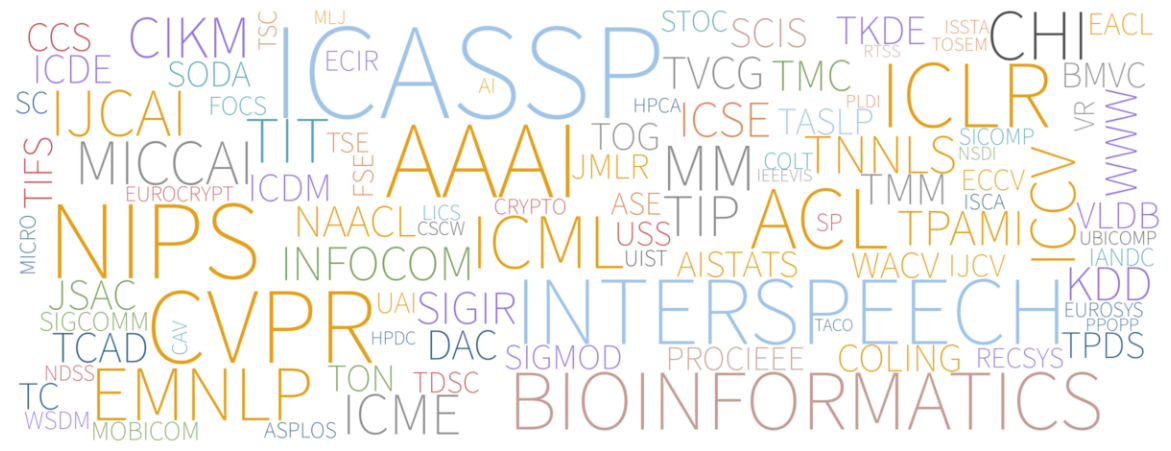
下列 4 张统计图与 cache.jsonl.gz 同源同步,反映本数据集的最新状态。The four charts below are generated from the same cache.jsonl.gz and always reflect the latest state of this dataset.



📦 数据集内容 · What's in this dataset
| 路径 Path | 子集 Subset | 格式 Format | 说明 Description |
|---|---|---|---|
cache/cache.jsonl.gz |
papers(默认 / default) |
gzip-compressed JSON Lines (UTF-8) | 每行一篇论文 · One paper per line; one JSON object per line |
cache/abstract_backfill_progress.jsonl.gz |
abstract_backfill_progress |
gzip-compressed JSON Lines (UTF-8) | 摘要回填流水线的进度/断点记录,不是论文元数据;仅供工作流恢复使用 · Append-only progress log of the abstract-backfill pipeline (not paper records); used by the workflow to resume between runs |
Hugging Face 会自动为 cache.jsonl.gz 生成 Parquet 视图,也可直接用 datasets.load_dataset(...) 读取,无需手动解压。Hugging Face also exposes an auto-generated Parquet view, so datasets.load_dataset(...) works out of the box.
💡 Dataset Viewer 与
datasets.load_dataset("youngfish42/PaperVault")默认展示/加载的都是papers子集(即cache/cache.jsonl.gz)。如需查看回填进度,请在 Viewer 顶部下拉框切换到abstract_backfill_progress,或调用load_dataset("youngfish42/PaperVault", name="abstract_backfill_progress")。The Dataset Viewer anddatasets.load_dataset("youngfish42/PaperVault")both default to thepaperssubset (cache/cache.jsonl.gz). To inspect backfill progress, switch the Viewer's subset dropdown toabstract_backfill_progressor callload_dataset("youngfish42/PaperVault", name="abstract_backfill_progress").
📐 字段 Schema
| Field 字段 | Type 类型 | Notes 说明 |
|---|---|---|
paper_name |
string | 论文标题(已归一化)· Normalised paper title |
paper_authors |
list[string] | 作者列表,按原始顺序 · Author names in order |
paper_url |
string | 论文在原始平台的链接(PDF 或落地页)· Canonical URL on the venue's site (PDF or landing page) |
paper_abstract |
string | 摘要;未回填时为空字符串 · Abstract; may be empty when not yet backfilled |
paper_code |
string | 从摘要中抽取出的 GitHub 仓库 URL;"#" 是「未发现代码链接」的占位符 · GitHub repository URL extracted from the abstract; "#" is the sentinel for "no code link discovered" |
conf |
string | 会议+年份标识,如 ACL2024、NIPS2023、CVPR2025;去掉末尾四位数字即可得到会议系列。注意 NeurIPS Proceedings 沿用历史命名 NIPS{year}。Venue + year identifier (e.g. ACL2024, NIPS2023, CVPR2025). Strip the trailing 4-digit year to recover the venue series. Note that NeurIPS Proceedings entries use the historical name NIPS{year}. |
缺失字段请按空字符串处理。Treat missing fields as empty strings.
⬇️ 获取方式 · How to download
下面三种方式任选其一即可,无需克隆 GitHub 仓库。Pick any one of the three options below — no GitHub clone is required.
方式 A · Option A — huggingface_hub(推荐 / recommended)
from huggingface_hub import hf_hub_download
import gzip, json

path = hf_hub_download(
    repo_id="youngfish42/PaperVault",
    filename="cache/cache.jsonl.gz",
    repo_type="dataset",
)

with gzip.open(path, "rt", encoding="utf-8") as f:
    for line in f:
        record = json.loads(line)
        # 在这里处理一条记录 · do something with the record
方式 B · Option B — datasets
from datasets import load_dataset

ds = load_dataset("youngfish42/PaperVault")
print(ds[next(iter(ds))][0])
数据集只有一个默认 split(非 ML 训练集),不要传
split="train"。Single default split — do not passsplit="train".
方式 C · Option C — huggingface-cli / 直接 HTTPS · Plain HTTPS
huggingface-cli download youngfish42/PaperVault \
    cache/cache.jsonl.gz --repo-type dataset --local-dir ./data
💡 文件压缩后约 120 MB(会随数据持续增长),解压后是 GB 级 JSONL 流,请按行流式读取,不要整体载入内存。The file is ~120 MB compressed (and growing) and decompresses to a multi-GB JSONL stream. Stream it line-by-line rather than loading the whole thing into memory.
🔁 更新节奏 · Update cadence
数据集由三个 GitHub Actions 工作流负责重建并推送到本 Hub 仓库 / The dataset is rebuilt and pushed to this Hub repo by three GitHub Actions workflows:
| 工作流 Workflow | 触发节奏 Schedule | 推送的内容 What it pushes |
|---|---|---|
collect_papers |
每月 15 号 16:00 UTC + 手动触发 · 15th of every month at 16:00 UTC + workflow_dispatch |
增量抓取新发现的会议/年份组合 · Incremental crawl of newly-discovered conference/year combinations |
backfill_abstracts |
每月 1 号 00:00 UTC + 手动触发 · 1st of every month at 00:00 UTC + workflow_dispatch |
为已有论文回填 paper_abstract · Adds paper_abstract for papers that were collected without one |
update_readme |
仅手动触发 (workflow_dispatch) · Manual only (workflow_dispatch) |
默认仅刷新 README 与统计;当输入参数 mode=force 时执行全量重建 · Refreshes the README and statistics by default; performs a full rebuild only when invoked with mode=force |
每次推送都使用 Hugging Face 的 parent_commit 乐观锁机制,避免并发覆盖。Each push uses Hugging Face's parent_commit optimistic-lock mechanism to avoid silently overwriting concurrent updates.
🌐 线上服务 · Live Service
无需下载数据集即可直接体验 Web 检索: No need to download the dataset — try the web search directly:
🔗 关联仓库 · Related repository
如果你需要完整的搜索 Web UI(智能搜索 + Web of Science 风格的高级查询 DSL)、REST API(/api/v1/*)、抓取 / 合并 / 摘要回填流水线源码、收录会议范围、统计仪表盘、项目截图或贡献指南,请前往 GitHub 项目仓库。If you are looking for the full search Web UI (smart search + Web-of-Science-style advanced query DSL), the REST API (/api/v1/*), the crawling / merging / abstract-backfill pipelines source code, conference coverage, statistics dashboards, screenshots or contribution guidelines, please visit the GitHub repository.
👉 github.com/youngfish42/PaperVault
📜 许可证 · License
代码以 GPL-3.0 发布;每条论文记录的著作权仍属于原作者 / 出版方,本数据集仅重新分发公开可获取的元数据与链接。Code is released under GPL-3.0; individual paper records remain the IP of their authors/publishers — this dataset only redistributes publicly available bibliographic metadata and links.
- Downloads last month
- 1,301